


German working term: Strukturmechanik
English term: Structural Mechanism
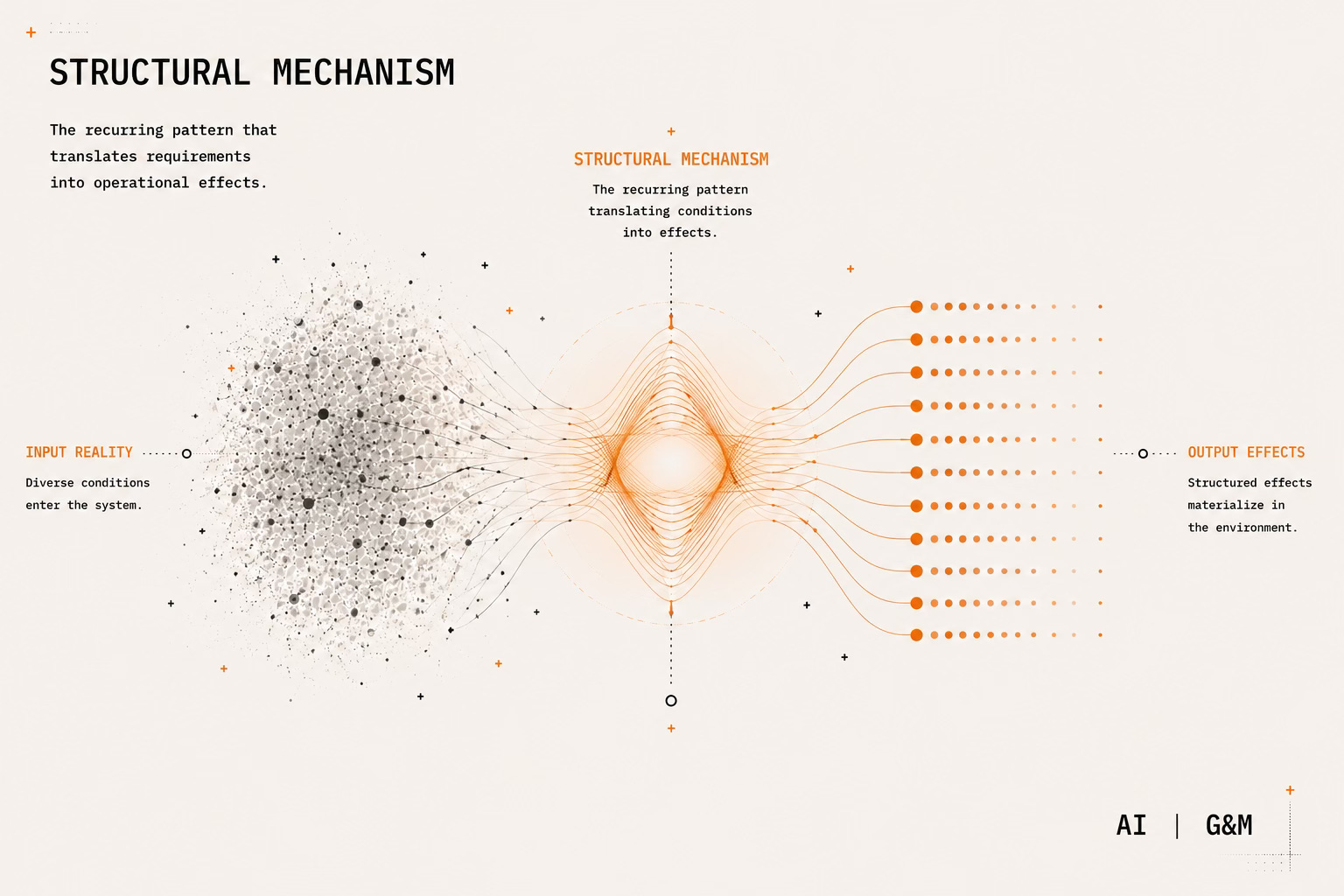
Short definition
A Structural Mechanism describes the common structural logic underlying recurring adaptations that become observable under comparable Operational Tensions across different contexts.
It explains not individual events, but the recurring pattern that connects these adaptations.
What real-world problem does this mechanism describe?
Organizations, markets, and institutions constantly change. Many of these changes are remarkably similar, even though they emerge independently of one another.
Organizations introduce similar documentation processes. They establish comparable governance roles. They create similar control or admission structures.
Viewed individually, these developments often appear to be organization-specific solutions or isolated management decisions. As a result, the underlying structural logic frequently remains invisible.
A Structural Mechanism makes this common logic visible.
It does not describe the individual adaptations themselves, but the recurring pattern that underlies them.
Mechanism
Comparable Operational Tensions frequently give rise to similar structural adaptations.
These adaptations may take the form of:
new organizational roles,
additional processes,
modified decision pathways,
new governance structures,
organizational reconfiguration,
new verification or control structures.
When such adaptations repeatedly emerge across different organizations or application contexts, their common structural logic can be reconstructed.
AI GM refers to this common structural logic as a Structural Mechanism.
The Structural Mechanism itself is not directly observable. What can be observed are the individual adaptations. The Structural Mechanism describes the recurring pattern that connects them.
Why is it important?
A Structural Mechanism shifts attention from isolated events to recurring patterns of organizational adaptation. This makes it possible to understand individual developments as part of a broader structural movement rather than as unrelated cases.
It enables analysts to:
connect seemingly separate observations,
compare developments across organizations and sectors,
and identify structural change at an earlier stage.
A Structural Mechanism therefore forms the explanatory layer between observable reality and concrete decisions.
Reality Anchors
Structural Mechanisms are grounded in recurring observations.
Typical Reality Anchors include:
similar organizational adaptations,
recurring governance structures,
comparable market responses,
similar regulatory consequences,
repeated changes in roles or processes,
independent empirical observations of the same adaptation pattern.
A single Reality Anchor is not sufficient.
Only the repeated occurrence of similar adaptations across different contexts allows a Structural Mechanism to be reconstructed.
Limits of the mechanism
A Structural Mechanism does not describe a universal law. Organizations may respond differently to the same Operational Tension. Likewise, a Structural Mechanism does not describe an individual organizational measure.
It describes only the common structural logic underlying recurring adaptations.
Whether observed adaptations actually belong to the same Structural Mechanism must always be reconstructed from observable reality.
Related mechanisms
Governance Capacity
Verification Requirement
Admission Layer
AI G&M connection
The Structural Mechanism forms the central explanatory layer of AI Governance & Markets. It connects observable reality with recurring forms of organizational, institutional, and market adaptation.
Nearly all later mechanisms within the Encyclopedia - such as Verification Requirement, Governance Capacity, Runtime Governance, or Admission Layer—can be understood as specific Structural Mechanisms. They describe particular recurring forms of structural adaptation that emerge under comparable Operational Tensions.
Common misunderstandings
A Structural Mechanism is not a theory.
A Structural Mechanism is not an individual event.
A Structural Mechanism is not a universal law.
A Structural Mechanism does not describe a single organizational measure.
Not every recurring observation constitutes a Structural Mechanism.
Structural Mechanisms are not directly observable; they are reconstructed from recurring structural adaptations.
A Structural Mechanism explains the common logic of recurring adaptations, not every individual action.
Level 1 – Foundations
Status: Fundamental