


German working term: Entscheidungsschwelle
English term: Decision Threshold
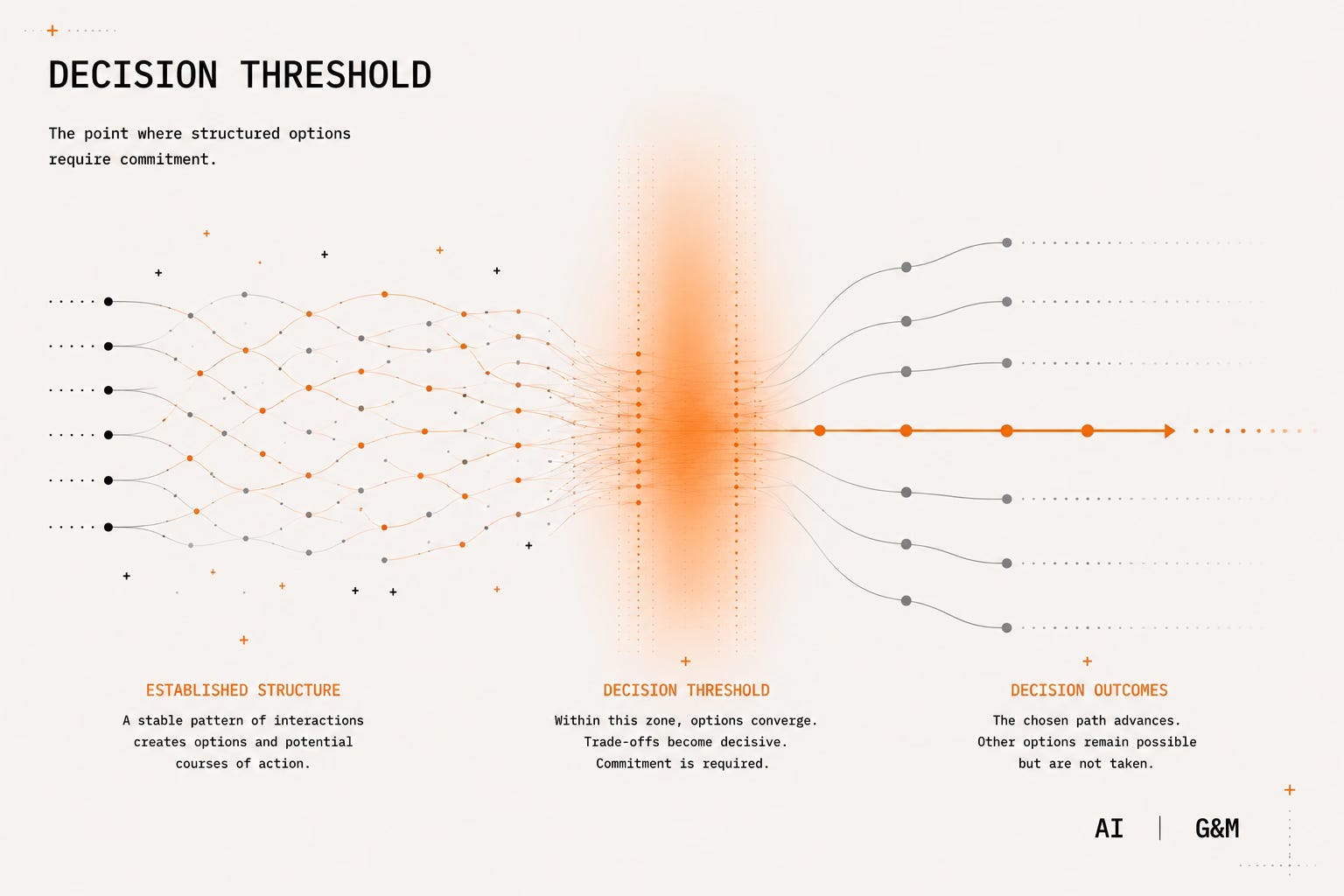
Short definition
A Decision Threshold describes the transition zone in which a Structural Mechanism turns into a real consequence.
It marks the point at which organizational, technical, or institutional possibilities become a new binding state.
What real-world problem does this mechanism describe?
Organizations develop processes, rules, and governance structures to prepare decisions and manage risk. These structures remain without effect until they are translated into real-world consequences.
Only at specific transitions is it determined:
whether an action will be executed,
whether access will be granted,
whether a system will be approved,
whether a payment will be initiated,
whether market access will be granted,
or whether an organizational consequence will take effect.
These transitions are often more important for governance than the preceding processes themselves. A Decision Threshold describes exactly this transition zone.
Mechanism
Before a Decision Threshold is crossed, multiple courses of action remain possible. Information may still be added, evidence collected, risks assessed, or alternatives considered. Once the threshold is crossed, however, a new real-world state emerges.
An action is executed.
Access is granted.
A product enters the market.
A payment is made.
An agent acts.
A Decision Threshold does not describe the decision itself. It describes the transition zone in which possibilities become real consequences. This transition may be triggered by human decisions, organizational procedures, technical rules, or automated control mechanisms.
The form of the transition may differ. The underlying mechanism remains the same.
Why is it important?
A Decision Threshold identifies where governance actually becomes effective. Rules, processes, and organizational structures do not create impact uniformly. Their real significance lies at the transitions where preparatory possibilities become binding consequences.
This makes it clear that governance does not primarily exist in documents or organizational charts. It exists at the thresholds where actions are permitted, constrained, delayed, or prevented.
A Decision Threshold therefore connects Structural Mechanisms with operational reality.
Reality Anchors
Decision Thresholds may become visible through:
formal approval procedures,
admission processes,
conformity assessments,
human oversight requirements,
runtime checks,
policy enforcement,
API authorization,
access control decisions,
payment authorization,
deployment approval.
Reality Anchors reveal the observable consequences. The Decision Threshold reconstructs the transition zone in which these consequences become binding.
Limits of the mechanism
Not every decision represents a Decision Threshold. Routine decisions without structural significance do not belong to this mechanism.
Likewise, a Decision Threshold does not describe the quality of a decision or the responsibility of individual actors.
It describes only the transition zone in which multiple possible states are reduced to one real consequence. A decision is the most common, but not the only, form of this transition.
Related mechanisms
Governance Capacity
Verification Requirement
Admission Layer
AI G&M connection
The Decision Threshold forms the fourth step of the AI GM reconstruction logic.
Reality Anchor → Operational Tension → Structural Mechanism → Decision Threshold
Reality Anchors make observable reality visible. Operational Tensions create adaptation pressure. Structural Mechanisms describe the common logic underlying recurring adaptations. At Decision Thresholds, these adaptations become real consequences.
Many specialized AI GM mechanisms describe different forms of Decision Thresholds. These include, for example:
Admission Layers,
Runtime Governance,
Human Approval,
Policy Enforcement,
Commit-Time Governance,
Agentic Payments,
Runtime Admission.
Although they differ in implementation, they all follow the same underlying mechanism: They determine the conditions under which possibilities become binding consequences.
Common misunderstandings
A Decision Threshold is not the decision itself.
A Decision Threshold is not a single moment in time.
A Decision Threshold is not an organizational role.
Not every decision constitutes a Decision Threshold.
Decision Thresholds may be human, organizational, technical, or automated.
A Decision Threshold describes the transition to a real consequence, not the entire decision-making process.
A Decision Threshold may extend across multiple process steps rather than existing as a single formal approval point.
Level 1 – Foundations
Status: Fundamental