


German working term: Operative Spannung
English term: Operational Tension
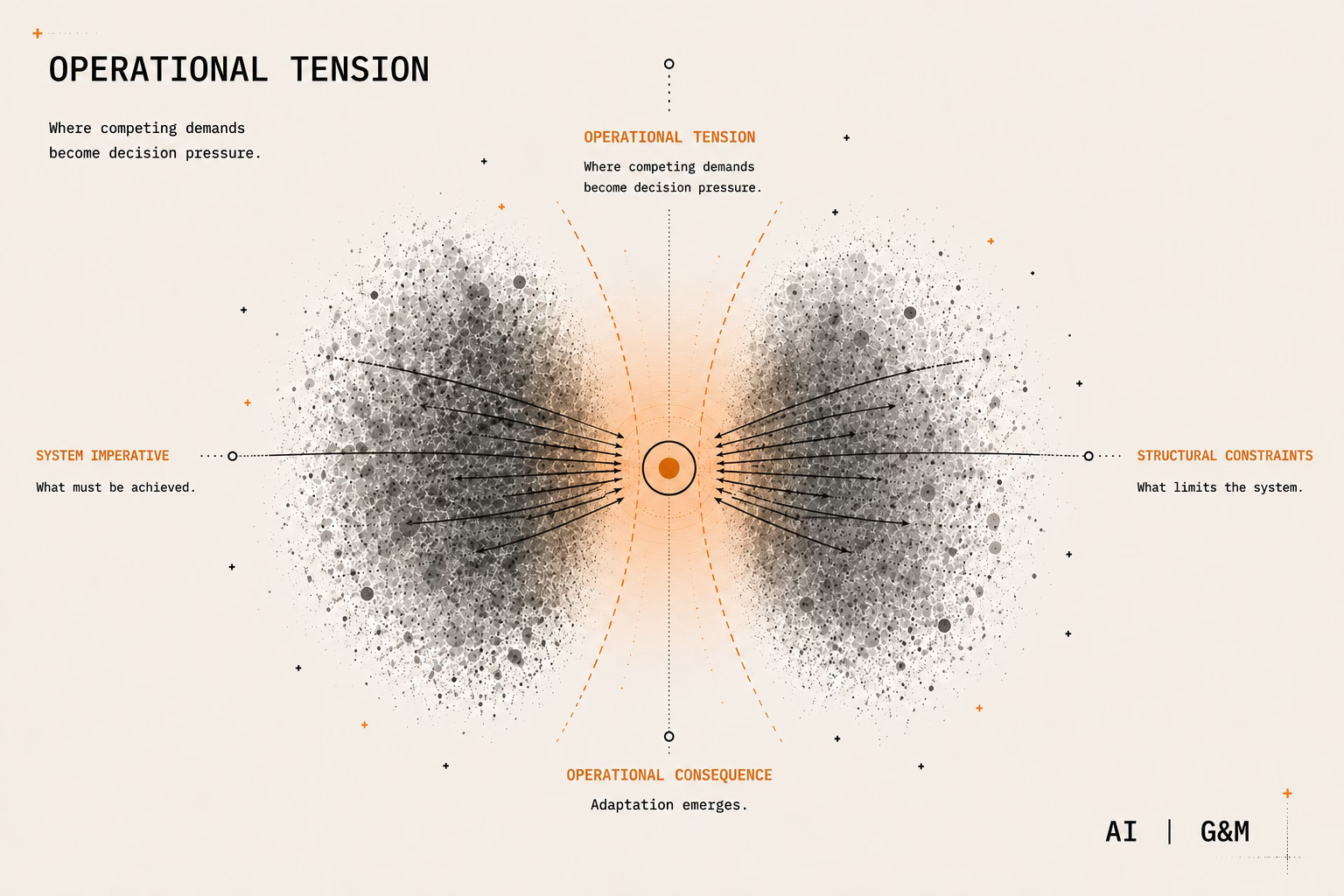
Short definition
An Operational Tension describes a real conflict between operational requirements that cannot all be fully satisfied under existing conditions. It creates adaptation pressure and forms the starting point of structural change.
What real-world problem does this mechanism describe?
Observable reality alone does not explain why organizations, markets, or institutions change.
Between an observable reality and a later structural change, an operational tension often emerges first. Different legitimate requirements simultaneously act upon the same resources, processes, or decision structures, yet cannot all be fully satisfied.
Examples include:
speed versus control,
innovation versus regulatory verifiability,
automation versus human oversight,
openness versus security.
Without reconstructing this operational tension, subsequent organizational changes often appear to be isolated management decisions or unique cases.
Operational Tension makes this otherwise invisible layer of adaptation pressure reconstructable.
Mechanism
An Operational Tension emerges when multiple operational requirements exist simultaneously, but the prevailing conditions prevent them from being fully reconciled.
These conditions may include:
limited time,
constrained resources,
regulatory requirements,
technical limitations,
organizational structures,
institutional constraints.
This creates operational adaptation pressure.
Organizations respond by introducing, for example:
new processes,
additional governance structures,
revised organizational roles,
prioritization,
organizational redesign,
or new capabilities.
When comparable Operational Tensions repeatedly occur across different contexts and consistently produce similar forms of adaptation, a Structural Mechanism can be reconstructed.
Operational Tension therefore describes the transition from observable reality to structural adaptation pressure.
Why is it important?
Operational Tension explains why Structural Mechanisms emerge.
It prevents organizational changes from being derived directly from isolated observations or events.
Instead, it reconstructs the operational pressure underlying the observed adaptations.
This makes it possible to understand why similar organizational solutions repeatedly emerge in different contexts.
The explanation therefore shifts from individual events to the conditions under which organizations must operate.
Reality Anchors
Operational Tensions may become visible through, for example:
recurring implementation problems,
regulatory trade-offs,
documented governance bottlenecks,
prolonged development or approval processes,
organizational restructuring,
new documentation and control processes,
recurring human intervention in automated workflows,
procurement or integration constraints,
recurring prioritization conflicts.
Limits of the mechanism
Not every difficulty constitutes an Operational Tension.
Personal conflicts, isolated management failures, or temporary implementation problems do not, by themselves, constitute an Operational Tension.
Likewise, the mechanism describes only the adaptation pressure.
It does not yet explain the specific form of the resulting Structural Mechanism.
Related mechanisms
Governance Capacity
Organizational Layering
Verification Requirement
AI G&M connection
Operational Tension represents the second step of the AI GM reconstruction logic.
Reality Anchor → Operational Tension → Structural Mechanism → Decision Surface
Reality Anchors describe observable reality.
Operational Tension reconstructs the adaptation pressure emerging from that reality.
Structural Mechanisms explain the recurring forms of adaptation.
Decision Surfaces identify where organizations or institutions must actually make decisions.
Operational Tension therefore connects observation with structural explanation.
Common misunderstandings
An Operational Tension is not a personal conflict.
An Operational Tension is not a management problem.
An Operational Tension is not a Structural Mechanism.
Not every operational problem is an Operational Tension.
Operational Tension describes adaptation pressure, not its solution.
Operational Tensions are reconstructed from observable reality rather than assumed theoretically.
Resolving one Operational Tension may generate new Operational Tensions.
Level 1 – Foundations
Status: Fundamental